
If you have spent any time scrolling through interior design accounts or browsing property listings in Bognor Regis, Chichester, or Arundel, you will have noticed a recurring theme: space. Specifically, wide, uninterrupted, sun-drenched open-plan spaces. Whether it’s a kitchen-diner that flows seamlessly into the garden via bi-fold doors or a massive family room where everyone can congregate without tripping over each other, the "open-plan" dream is at the top of most homeowners' wish lists.
However, there is a technical reality behind those beautiful photos that rarely gets the spotlight: the Steel Beam, often referred to in the trade as an RSJ (Rolled Steel Joist).
At Swanbourne Construction Ltd, we know that while steel beams aren't the most "glamorous" part of a renovation: you can’t pick their colour from a Farrow & Ball chart: they are arguably the most critical. They are the invisible muscle holding your house together. If you are planning a house extension in West Sussex, understanding why these beams are necessary is the first step to a successful, safe, and stunning build.
1. The Foundation of the Open-Plan Dream
Why we can't just "knock through" a wall without support.
Most traditional homes in our corner of West Sussex were built with a cellular layout: lots of small rooms separated by solid walls. Many of these are load-bearing walls, which means they aren’t just there for privacy; they are actively supporting the weight of the floors above, the roof, and even the external pressure of the building's structure.
When you decide to remove one of these walls to create that airy feel, that weight doesn't simply disappear. It needs to be redistributed. This is where the RSJ comes in.
An RSJ is a heavy-duty steel beam designed to take the massive vertical and horizontal loads of a building and "bridge" the gap created by the removed wall. Without it, the structural integrity of your home is compromised, leading to sagging floors, cracked masonry, or in extreme cases, total structural failure.
2. Understanding the Technical Side: I-Beams vs. H-Beams
Choosing the right "skeleton" for your extension.
In the world of construction, not all steel is created equal. When we talk about RSJs, we are generally looking at two main profiles:
- The I-Beam: As the name suggests, the cross-section looks like a capital "I". These are incredibly efficient at resisting bending and are the standard choice for most internal wall removals.
- The H-Beam (Universal Columns): These have wider flanges and are shaped more like a square "H". They are often used when the beam needs to support extreme weight or when it is being used vertically as a column.
The beauty of steel is its exceptional strength-to-weight ratio. Unlike timber beams, which would need to be incredibly thick (and take up valuable ceiling height) to support a modern house, a relatively slim steel beam can do the job with ease. This allows us to keep your ceilings as high as possible, maintaining that feeling of space that you’re investing in.
3. The Role of the Structural Engineer
Why "guessing" the beam size is a recipe for disaster.
One of the most common questions we get at Swanbourne Construction Ltd is: "Can’t the builder just tell me what size steel I need?"
The short answer is: No.
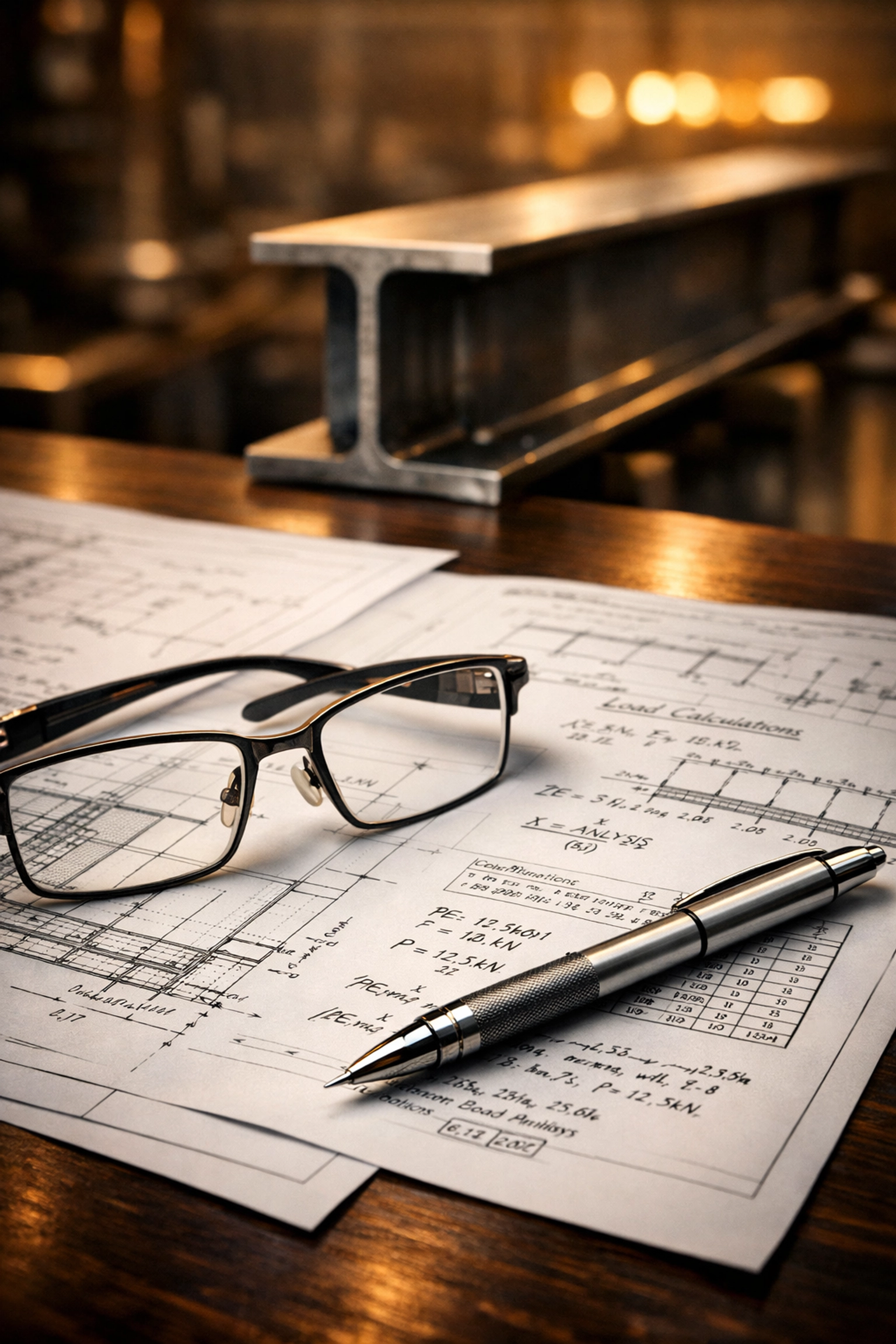
Every house is a unique puzzle of weights and forces. A beam that works for your neighbour’s extension might be completely inadequate for yours. To ensure safety and compliance, you must hire a Structural Engineer. They will perform precise calculations based on:
- The span of the opening.
- The weight of the materials above (brickwork, timber, tiles).
- "Live loads" (furniture, people, and even snow on the roof).
- The condition of the existing foundations where the beam will rest.
These calculations are not just for your peace of mind; they are a legal requirement. You will need to submit these drawings and calculations to Building Control to get your completion certificate. Without this, you may find it impossible to sell your home in the future.
4. The Installation Journey: Precision and Power
What actually happens on-site?
Installing a steel beam is one of the most high-stakes days on a building site. It requires a mix of brute force and surgical precision.
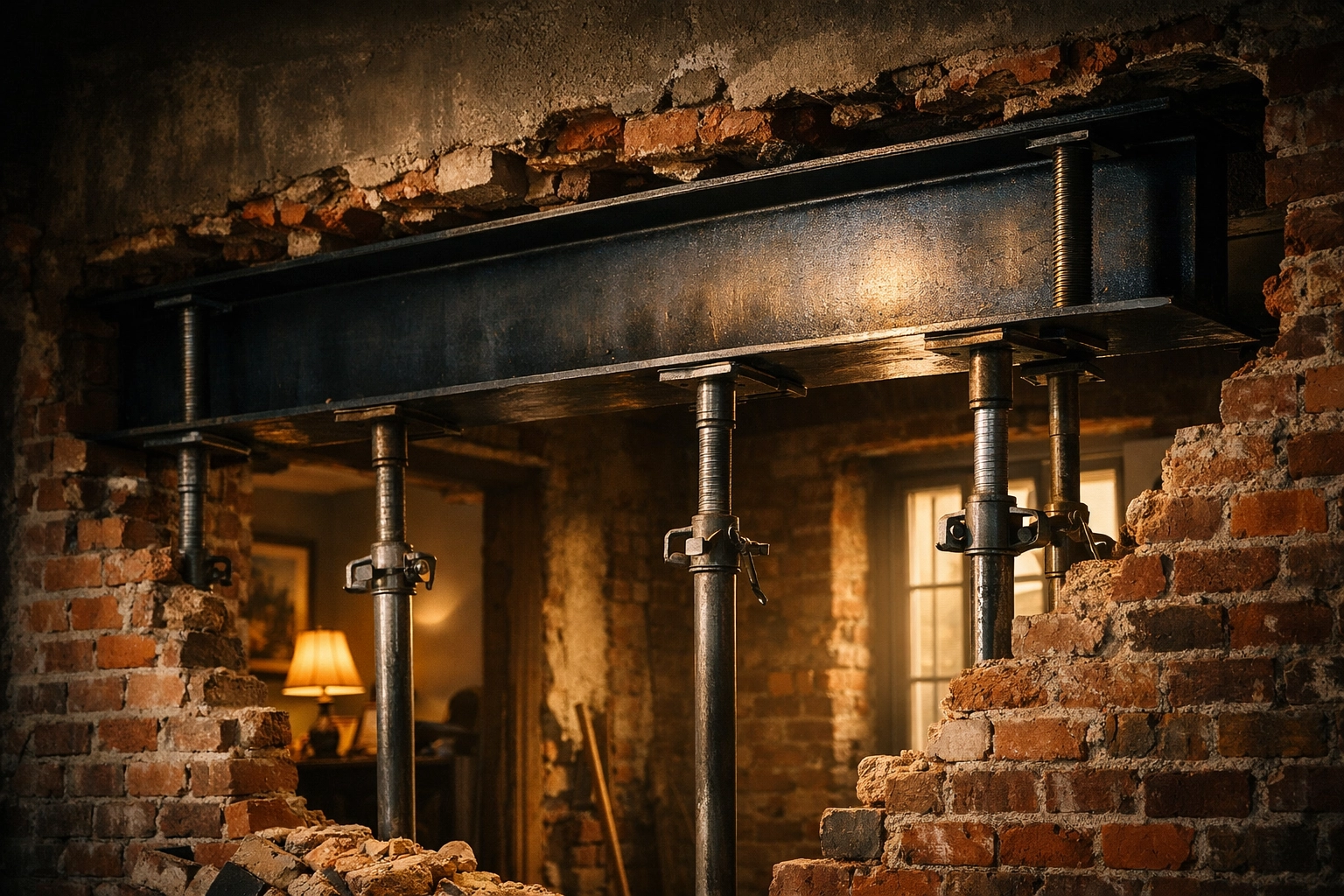
- Temporary Support (Acrow Props): Before a single brick is removed, we install "strongboys" and "acrow props": adjustable steel jacks: to take the weight of the house while the wall is taken down.
- The Padstones: A steel beam cannot sit directly on standard bricks; the concentrated weight would crush them. We install concrete padstones at either end of the opening to spread the load across the remaining masonry.
- The Lift: Depending on the size of the beam, this might involve a team of strong builders, a "Genie lift" (a manual material hoist), or in some of our more ambitious projects in Chichester or Bognor, a crane to drop the steel in from above.
- Dry Packing: Once the beam is in place, we use a non-shrink slate or high-strength mortar (dry packing) to ensure there is a perfect, solid connection between the top of the steel and the masonry above.
5. Beyond Support: Large Spans and Bi-Fold Doors
Creating the "Glass Wall" effect.
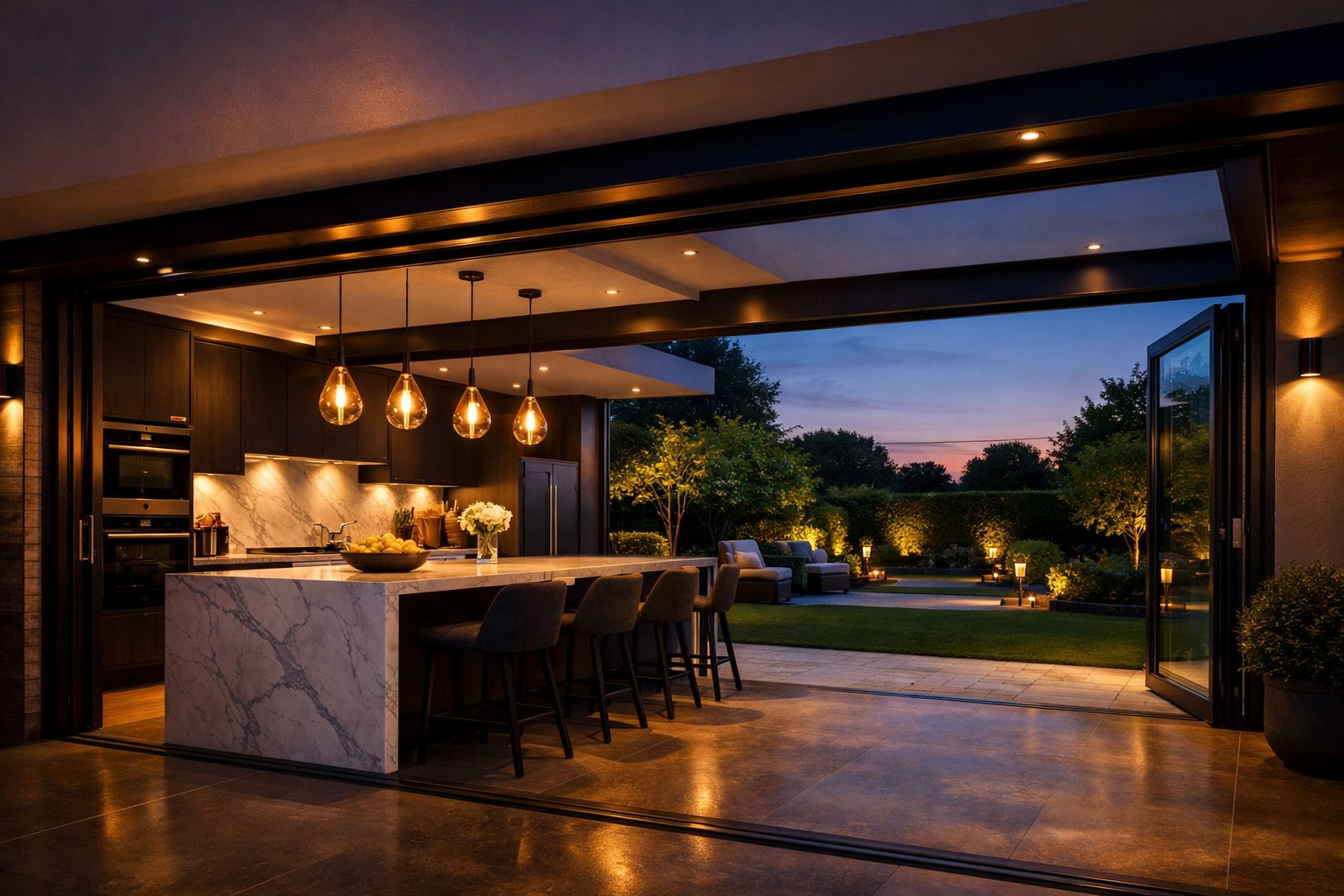
If you are planning a rear extension, you likely want a large set of bi-fold or sliding doors. Modern glass is heavy, and the roof above those doors needs serious support.
In these scenarios, we often use a "Goalpost" frame. This consists of a horizontal steel beam supported by two vertical steel columns. This frame acts as a self-supporting unit, allowing us to remove almost the entire back wall of your house and replace it with glass. It is this specific application of steel that has transformed modern British architecture, moving us away from small windows and dark rooms into the light-filled homes we see today.
6. Fire Protection and Aesthetics
Keeping it safe and looking good.
Steel is incredibly strong, but it has a weakness: extreme heat. In the event of a fire, unprotected steel can soften and lose its structural integrity.
Building Regulations require all residential steel beams to be fire-protected. This is usually done by "boxing in" the beam with two layers of fire-rated plasterboard. This is why you often see a slight "dropped" section in the ceiling of open-plan rooms.
However, some homeowners prefer the "Industrial Look." If you want your RSJ to be exposed as a design feature, it must be treated with special intumescent paint, which expands when heated to protect the metal. It’s a fantastic way to add character to a modern renovation.
7. Is an RSJ Worth the Cost?
Investment vs. Disruption.
There’s no denying that structural steel adds to the budget. Between the engineer’s fees, the cost of the steel itself (which fluctuates with global markets), and the labour to install it, you are looking at a significant investment.
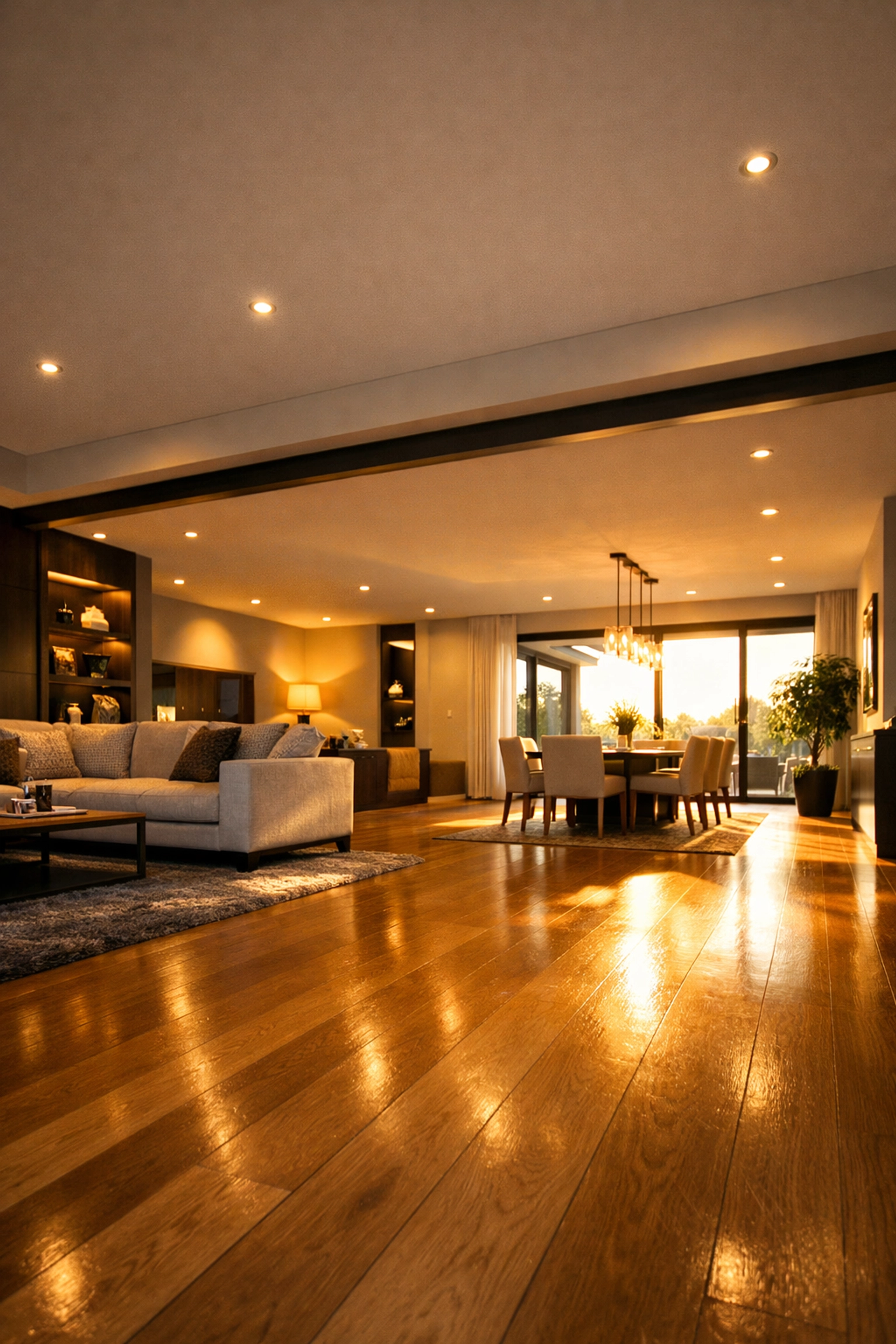
However, the Return on Investment (ROI) for an open-plan extension is consistently among the highest in the UK property market. By removing walls and using steel to create a functional, modern layout, you aren't just adding square footage; you are fundamentally changing how the house feels and functions. A house that "flows" is always more desirable to buyers in West Sussex than one that feels cramped and dated.
8. Why Choose Swanbourne Construction Ltd for Your Extension?
Local expertise you can trust.
Navigating the world of structural engineering, building regs, and heavy lifting can be daunting. That’s why we take a consultative approach. We don't just "bash down walls": we plan, we calculate, and we execute with the precision that a structural project demands.
Whether you are looking for builders in Westergate or a full project management service for a loft conversion in Bognor Regis, we ensure that the "invisible" parts of your build: like your steel beams: are handled with as much care as the final finishes.
Ready to open up your living space?
The dream of an open-plan home is closer than you think. If you’re wondering how much your project might cost or if your wall is load-bearing, the best place to start is with a conversation.
Contact Swanbourne Construction Ltd today for a professional consultation. Let’s look at your home’s potential together and build something that isn't just beautiful, but built to last for generations.