
If you live in West Sussex, you already know the dilemma. You love your neighborhood, whether it’s the coastal charm of Bognor Regis, the historic streets of Chichester, or the market-town feel of Arundel, but your home is starting to feel a little tight. Perhaps a new arrival is on the way, you’ve permanently moved to a remote-working model, or you simply need a sanctuary away from the chaos of the ground floor.
Moving house in the current market can be an expensive, stressful ordeal. Between estate agent fees, Stamp Duty, and the sheer upheaval of relocating, many homeowners are looking upward instead of outward. A loft conversion in West Sussex is one of the most effective ways to add significant square footage and value to your property without sacrificing your garden or your sanity.
But before you start picking out paint swatches for your new master suite, there is a fundamental question to answer: Is your roof actually ready for a conversion? Not every attic is immediately habitable, and understanding the physical and legal constraints of your specific property is the first step toward a successful build.
At Swanbourne Construction Ltd, we’ve transformed dozens of dusty attics into stunning living spaces. Here is our professional 5-step guide to assessing your roof’s potential.
1. The Tape Measure Test: Do You Have the Head Height?
The most critical factor in any loft conversion is the available head height. While you might be able to duck and crawl through your current attic to find the Christmas decorations, living in that space is a different matter entirely.
The 2.2-Metre Rule
To comply with UK Building Regulations, a habitable room generally requires a finished ceiling height that feels comfortable. In practical terms, for a loft conversion in West Sussex, you are looking for a minimum height of 2.2 metres (roughly 7 feet 2 inches) from the top of the existing ceiling joists to the underside of the ridge timber at the highest point.
Why the extra space matters
Keep in mind that this measurement is for the existing space. Once we install the necessary structural floor beams, insulation, and plasterboard, the floor will rise and the ceiling will drop. If your current height is exactly 2.2 metres, your finished room will likely be around 1.9 or 2.0 metres, perfectly legal, but potentially a bit "snug" for taller occupants.
What if your roof is too low?
If you fall short of the 2.2-metre mark, don't lose hope. There are solutions, such as "thin-profile" insulation or, in more complex cases, lowering the ceilings of the rooms below. However, these options increase the project's scope and budget.

2. Identify Your Roof Structure: Trusses vs. Rafters
How your roof was built determines how much structural intervention will be required. Generally, houses in West Sussex fall into two categories:
Traditional Rafter and Purlin Roofs
Common in pre-1960s homes, these roofs are constructed with relatively large timbers that leave a large, open void in the center. These are often the easiest and most cost-effective to convert because the "shell" of the room is already largely clear of obstructions.
Modern Trussed Roofs
If your home was built from the late 1960s onwards, it likely features "W-shaped" timber trusses. These factory-made frames are incredibly strong but fill the loft space with diagonal bracing. To convert a trussed roof, we must replace that internal bracing with steel beams and new floor joists before the old timbers can be removed.
While more complex, a trussed roof is absolutely convertible. It simply requires a higher level of structural engineering expertise, something we specialize in at Swanbourne Construction Ltd.
3. Choose the Right Conversion Type for Your Property
Not all loft conversions are created equal. The "ready-ness" of your roof often depends on which style of conversion best suits your home’s architecture and your budget.
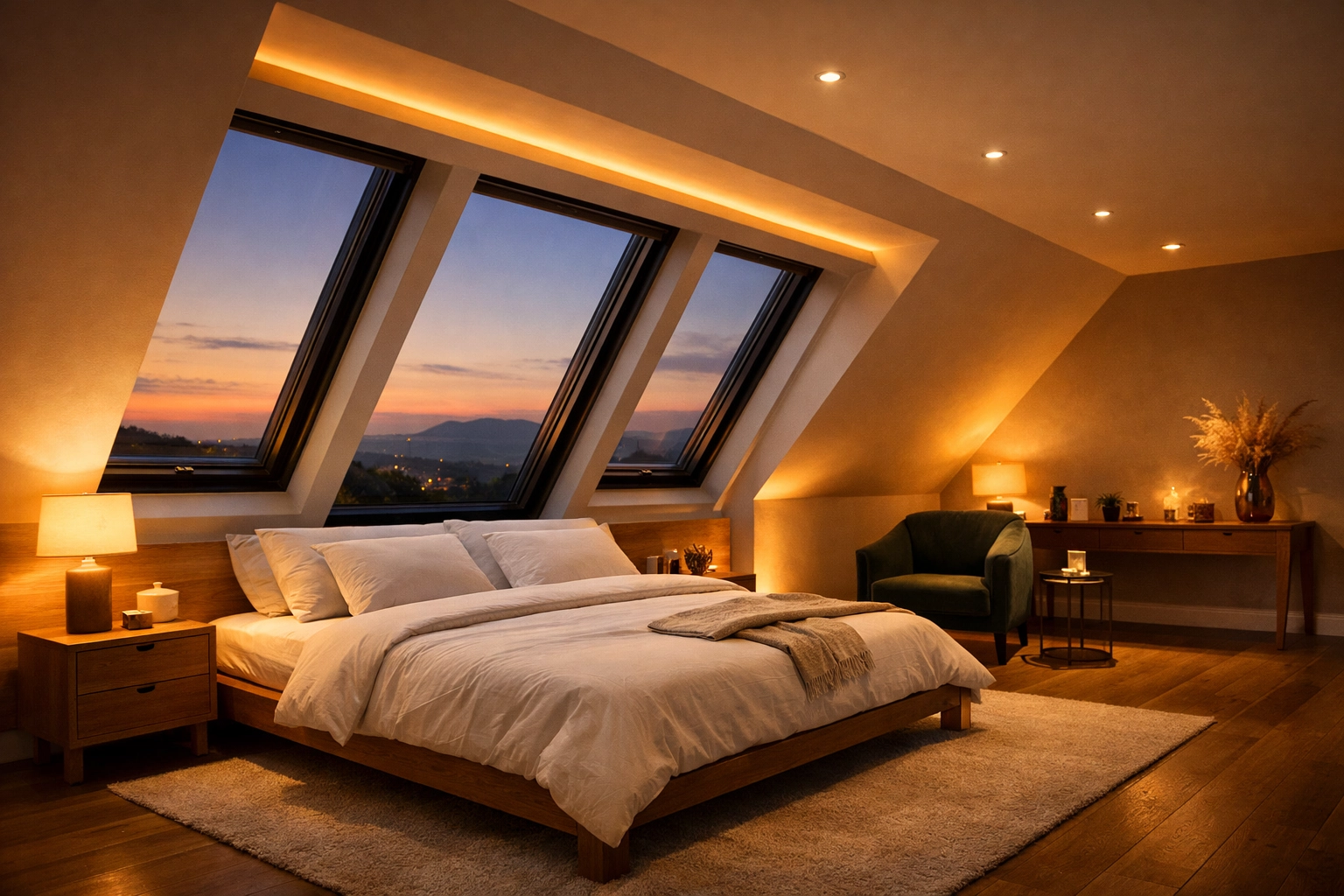
- Velux (Rooflight) Conversions: If you have ample head height and a generous floor area, a Velux conversion is the simplest route. We don’t change the shape of the roof at all; we simply install high-quality roof windows. This is often the preferred choice for loft conversions in Bognor Regis where homeowners want to maintain the original aesthetic of a terrace or semi-detached street.
- Dormer Conversions: This is the most popular choice in West Sussex. A dormer is an extension that protrudes vertically from a sloping roof. It creates a box-like shape that provides a flat ceiling and much more usable floor space. It’s the "gold standard" for creating a full master bedroom and ensuite.
- Hip-to-Gable Conversions: Many semi-detached and detached houses in our area have "hipped" roofs (roofs that slope on three or four sides). A hip-to-gable conversion extends the sloping side outward to create a vertical "gable" wall, dramatically increasing the internal volume.
4. Navigate the West Sussex Planning Landscape
One of the most common questions we get is: "Do I need planning permission?"
The good news is that many loft conversions in West Sussex fall under Permitted Development (PD) rights. This means you can often convert your loft without a full planning application, provided you stay within certain volume limits (usually 40 cubic metres for terraced houses and 50 cubic metres for semi-detached/detached) and don't exceed the height of the existing roof ridge.
The Local Context
However, West Sussex is home to many Conservation Areas and listed buildings, particularly in the hearts of Chichester and Arundel. If you live in one of these protected zones, your PD rights may be restricted or removed entirely. In these cases, a sympathetic design that respects the local heritage is essential to gaining approval from Arun or Chichester District Councils.
Before you start, it’s always worth checking your specific property's status. We often help clients navigate this by applying for a "Lawful Development Certificate," which provides written proof from the council that your conversion is legal and doesn't require full planning permission, a vital document when you eventually come to sell your home.
5. Account for Structural Integrity and Safety (The "Non-Negotiables")
Even if your roof is physically tall enough and the council says "yes," your home must be able to handle the new weight.
Load-Bearing Capacity
Your existing attic floor was designed to hold the weight of a few boxes and maybe a water tank: not a king-sized bed, a bathtub, and two adults. A professional assessment will determine where new steel beams need to be placed to transfer the load to the main structural walls of the house.
Fire Safety and Access
Building Regulations are there to keep you safe. Any loft conversion must include:
- Fire Doors: Usually, all doors leading to the protected stairwell on the floors below must be upgraded to fire-rated doors.
- Mains-Powered Smoke Alarms: Interlinked alarms on every floor.
- A Proper Staircase: Gone are the days of using a pull-down ladder to access a bedroom. To be considered a "habitable room," you must have a fixed staircase. This often means sacrificing a small part of a first-floor bedroom or a landing cupboard to make room for the new stairs.
Making the Move: Your Next Steps
Evaluating your roof is the first step in a journey that can completely transform how you experience your home. A well-executed loft conversion doesn't just add a room; it changes the flow of the entire house, often allowing you to reorganize the lower floors for better living.
If you’ve walked through these five steps and think your roof is a prime candidate for a makeover, the next stage is a professional feasibility study. At Swanbourne Construction Ltd, we pride ourselves on giving honest, expert advice to homeowners across West Sussex. Whether you are looking for a simple loft conversion in Arundel or a complex structural renovation in Bognor, we have the local knowledge to make it happen.
Don't leave your home’s potential untapped. If you’re ready to see what your attic could become, contact us today for a consultation. Let’s turn that empty roof space into the best room in the house.
Ready to see what else is possible? Browse our previous projects to see how we’ve helped your neighbors across West Sussex maximize their space.