
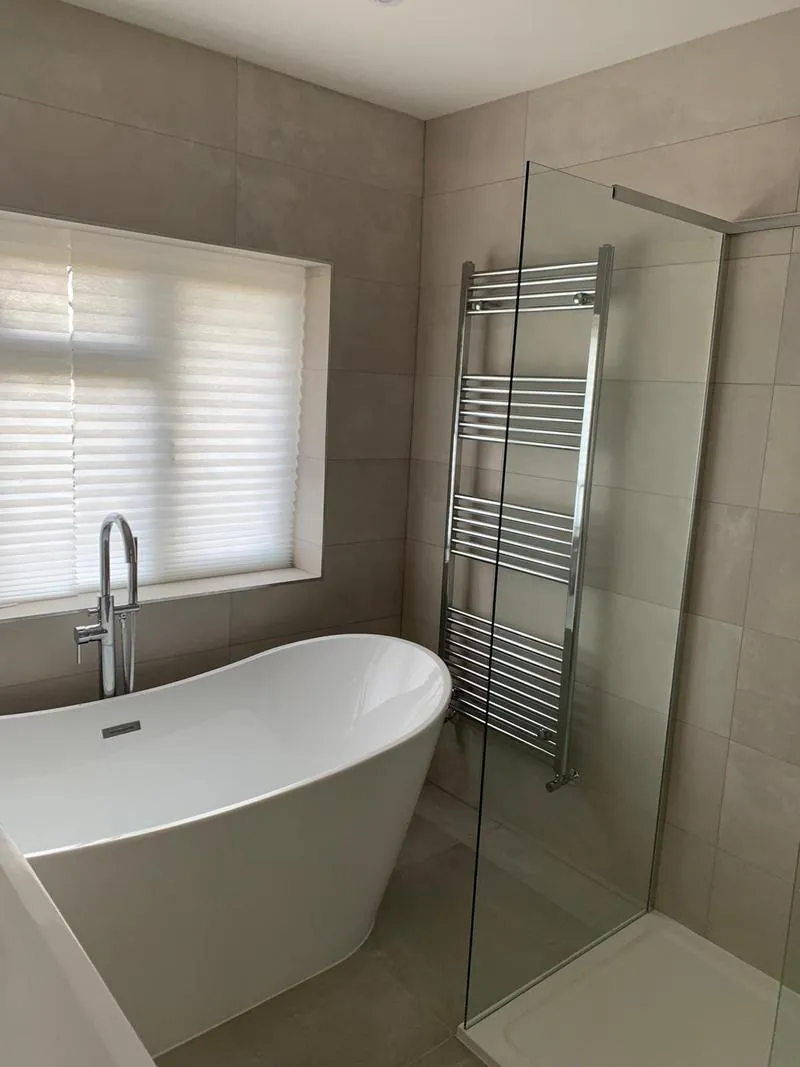
A bathroom refit around Bognor Regis and Chichester costs between £4,800 and £21,600 including VAT on our price guide: £4,800 to £10,800 to swap a suite like for like, £9,600 to £21,600 for a full refit, £8,400 to £21,600 for a wet room or level-access shower, and £7,200 to £18,000 to build a new en-suite from scratch. What moves a bathroom up or down those bands is rarely the bath you choose. It is whether the WC stays where the soil pipe is, what is underneath the floor when it comes up, and whether the shower is a tray or a tanked floor.
National cost guides put an "average" new bathroom at around £4,500 to £7,500. That is a realistic figure for a straight swap in a small room at national labour rates, and you will see it reflected at the bottom of our first band. It is not what a full refit with new pipework, electrics, tanking and floor-to-ceiling tiling costs on the South Coast, which is why the bands below are wider.
Bathroom prices, including VAT
| Work | Guide price | What it usually means |
|---|---|---|
| Like-for-like swap | £4,800 – £10,800 | Same layout, fittings in the same places, new suite, tiling and finishes |
| Full refit | £9,600 – £21,600 | New layout or fittings moved, new pipework and electrics, full tiling |
| Wet room or level-access shower | £8,400 – £21,600 | Floor formed to falls and tanked as a system, no tray |
| New en-suite built from scratch | £7,200 – £18,000 | New drainage, usually a stud wall, extraction to outside, new lighting circuit |
From our price guide. These are ranges, not quotations; a survey with the boards up turns them into a figure.
Those figures include the labour, the plumbing and electrical work, the tanking, the tiling, the strip-out and the making good. Sanitaryware, brassware and tiles can be supplied by us or by you; where you are choosing them they are listed separately so the two quotes you are comparing are describing the same thing.
What moves the price
Where the soil stack is
A WC needs a short, well-fallen run into a 110mm soil pipe. It is the one fitting that cannot be persuaded very far. Keep it near the stack and the room is a refit; move it across the room and you are cutting through joists or chasing a solid floor, which is what turns a swap into a full refit. Basins and showers are more forgiving on smaller wastes, but only if the floor has depth to give them a fall.
What is under the floor
Old bathrooms hide old leaks. Rotten joist ends under a tired shower tray or around the base of a WC are common, and they are found when the floor comes up, not before. A good quotation says how they will be dealt with if found. This is where a bathroom finds its true cost.
Tray or tanked floor
A shower tray sitting on the floor is a tray. A level-access floor is a tanked one: the whole wet area is waterproofed as a system — primer, membrane, taped corners — before a tile goes on. On a timber floor it is built into the joists; on the solid ground floors common in Bognor and Pagham bungalows, the falls are either built up above the slab or cut into it. It costs more because it is more work, and because it has to be right first time.
Tiles and finish
Floor-to-ceiling tiling in large-format porcelain takes longer, and costs more to cut and lay, than half-height ceramic. Wall panels are cheaper and quicker. Underfloor heating, a thermostatic valve built into the wall and concealed cisterns all add labour.

Where the money goes in a full refit
Every full bathroom refit, whatever the finish, goes through the same stages. Seeing them helps when you are comparing quotes, because a low price usually means one of them is missing.
- Survey. Boards up, the stack found, joist direction and depth checked, extraction checked.
- Strip-out and disposal. Old suite, tiles and often plasterboard out; skip and waste.
- Repairs. Rotten joists spliced, floors overboarded so they are rigid enough not to crack a grout line.
- First fix plumbing. New hot, cold and waste runs, any stack alteration, pressure tested.
- First fix electrics. Lighting, extractor, shaver point, towel rail or underfloor heating.
- Boarding and tanking. Cement or tile-backer board in wet areas, then the waterproofing system.
- Tiling. Walls, then floor, cut around the fittings.
- Second fix. Suite, taps, shower, screen, fan and lights fitted and tested.
- Finishing. Silicone, decoration, clean, and the electrical certificate and warranties handed over.
Do you need Building Regulations for a new bathroom?
Replacing a bathroom like for like does not normally need Building Regulations approval. Adding a bathroom where there was none — an en-suite, a loft shower room, a cloakroom under the stairs — does, because it involves new drainage, ventilation and often structure. But even in a straight refit, two parts of the job have rules of their own:
- Electrics. Under Part P, adding or altering circuits in the "special location" around a bath or shower is notifiable, as is any new circuit or consumer unit. That zone runs up to 2.25m above the floor and out 0.6m from the edge of the bath or tray. It has to be done by an electrician registered with a competent person scheme, who certifies it, or inspected by Building Control. All bathroom circuits need RCD protection.
- Extraction. Approved Document F sets a minimum extract rate for a bathroom of 15 litres a second for an intermittent fan, and it has to vent to outside air. A fan ducted into the loft rather than through the roof or wall is one of the commonest faults we find.
A new Approved Document F comes into force on 24 March 2027 alongside the Future Homes Standard; work started under the current rules is protected by transitional arrangements.
Wet rooms and level-access showers
A wet room has no shower tray: the floor itself falls gently to a drain, and the whole wet area is tanked. They suit small rooms, because a glass screen instead of a cubicle makes the space read larger, and they are the easiest bathroom in the world to use if anyone in the house has, or might one day have, trouble stepping over a tray edge.
National guides put a wet room at around £4,000 to £10,000. Our band of £8,400 to £21,600 including VAT reflects what the job involves on the coast: solid ground floors to be broken out or built up, a tanking system with a guarantee behind it, slip-rated tiles, and the pipework and electrics brought up to current rules at the same time. This autumn we start one on Rose Green Road in Pagham — the existing bathroom stripped back, the floor formed to falls and tanked, a walk-in shower with no step and no tray, and wall-hung sanitaryware.
If you are planning ahead rather than for next spring, a few things cost very little now and a lot to retrofit: a level threshold, a slip-rated floor tile, timber blocking behind the tiles so a grab rail can be fixed later into something solid, lever taps and a thermostatic valve.
Grants and VAT relief for accessible bathrooms
Disabled Facilities Grant
If a disabled person in the household needs an adapted bathroom, the council's Disabled Facilities Grant can pay for some or all of it. In England the mandatory grant is up to £30,000 — a limit unchanged since 2008, despite a government review. It is means-tested for adults (not for children), the disabled person has to intend to live in the house, and owners, tenants and landlords can all apply. The West Sussex councils, including Arun and Chichester, run a joint policy with some discretionary help above the mandatory grant; ask your council's housing team what applies.
One rule catches people out: do not start the work before the grant is approved, or it can be refused.
VAT relief for disabled people
Separately, under HMRC VAT Notice 701/7, a VAT-registered builder can zero-rate the work of providing, extending or adapting a bathroom, washroom or WC in a disabled person's home where it is needed because of their condition. That covers the building work, the related plumbing, drainage and electrics, and restoring the decoration immediately around it. It does not cover simply replacing an old suite like for like. The person must be chronically sick or disabled, not just elderly; they sign a short eligibility declaration, which we keep on file. For customers aged 60 or over, some items such as grab rails and built-in shower seats can be charged at the 5% reduced rate instead.
That is what the line on our footer means when it says some work, such as certain adaptations for disabled people, may be charged differently.
How long does a bathroom refit take?
- Like-for-like swap: around a week to ten days.
- Full refit: two to three weeks, depending on what is found under the floor and how much tiling there is.
- Wet room: longer, because screeds and tanking need time to cure and be tested before the tiles go on.
The biggest delay we see is not on site. It is a waste kit or a valve that has not arrived. We ask for everything to be on site and unwrapped before the old bathroom comes out, because a missing part stops the job dead. If it is your only bathroom, talk to us about the order of works — see living at home during building work.
Does a new bathroom add value?
A new bathroom makes a house easier to sell more than it moves the valuation. Which? Trusted Traders suggest a new bathroom might add a few per cent; an extra bathroom — an en-suite or a downstairs WC — tends to add more, because it changes what the house is. Nationwide's 2025 research said it could not reliably measure what kitchen and bathroom renovations add. So refit a bathroom because you need to, and add one because the house needs it.
Questions people ask about bathroom costs
How much does a new bathroom cost in 2026?
On our price guide, including VAT: £4,800 to £10,800 for a like-for-like swap, £9,600 to £21,600 for a full refit, £8,400 to £21,600 for a wet room and £7,200 to £18,000 for a new en-suite. National averages are lower because they usually describe a straight swap at national labour rates.
How long does it take to refit a bathroom?
Usually one to three weeks on site. A straight swap is around a week; a full refit with new pipework and full tiling is two to three; a wet room takes longer because the tanking and screed have to cure and be tested.
Do I need building regulations for a new bathroom?
Not for a like-for-like replacement. A new bathroom where none existed does need approval. In any refit, electrical work in the bath or shower zone must be certified by a registered electrician or inspected, and the extractor must meet the ventilation rules.
What size extractor fan does a bathroom need?
Approved Document F sets a minimum of 15 litres per second for an intermittent bathroom fan, vented to outside. A continuous-running fan can run at a lower rate. Ducting into the loft does not meet the rules.
How much does a wet room cost?
Our band is £8,400 to £21,600 including VAT. National guides quote £4,000 to £10,000, but a wet room on a solid floor, with a guaranteed tanking system, slip-rated tiles and new pipework and electrics, is usually towards our band.
What is tanking and do I need it?
Tanking is waterproofing the walls and floor of a wet area before tiling, with a primer, membrane and taped corners. Tiles and grout are not waterproof on their own. For walk-in showers and wet rooms it is essential; without it, leaks show up months later as joist damage.
How much is the Disabled Facilities Grant?
Up to £30,000 in England, means-tested for adults. The West Sussex councils can offer discretionary help above that in some cases. Do not start the work before the grant is approved.
Can I get VAT relief on a disabled bathroom?
Yes, if the work is needed because of a chronically sick or disabled person's condition. Providing, extending or adapting a bathroom or WC in their home can be zero-rated by a VAT-registered builder, with a signed eligibility declaration. A straight like-for-like replacement does not qualify.
Where these facts come from
- GOV.UK: Disabled Facilities Grants.
- HMRC VAT Notice 701/7: VAT reliefs for disabled people.
- Approved Document P: electrical safety in dwellings.
- Approved Document F: ventilation.
- MyBuilder: new bathroom cost and wet room cost (August 2026) — national averages.
- Which?: how much does a new bathroom cost (January 2026).
Price match guarantee

We will never compromise on quality but we will match any like-for-like price.
The words doing the work there are like-for-like. A quotation that comes in cheaper is usually describing a different job underneath. A shallower footing. A thinner unit of glass behind the same three words. Making good dropped, so the decorating lands back on you at the worst possible moment. A scaffold nobody priced, arriving in week three as an extra.
None of that makes the other builder a crook. It makes the two pieces of paper impossible to compare until somebody opens them both up, which is the whole reason ours arrives as over two hundred itemised lines rather than a figure at the bottom of a page.
So bring the other quotation to the site visit and we will go through it against ours, line for line. Either your price gets matched, or you find out what the cheaper number quietly leaves out — and either of those is worth an hour.
Read the price match guarantee terms — what counts as like-for-like, how long a match holds good, and why one builder's total can sit a fifth below another's before anybody has lifted a tool.
Related guides
How to compare builders' quotes line by line
Quote or estimate, provisional sums, exclusions, VAT and payment terms — how to put two prices side by side and see the same job.
Read the guideKitchen extension or kitchen refit: which makes more sense?
Refit, knock through or extend: the cost of each, what adds value, planning and Building Control, and the questions that decide it.
Read the guideLiving at home during an extension or renovation: what to expect
Dust, noise, kitchen downtime, builders' hours, toilets, skips, your insurer and asbestos — and when moving out is genuinely worth it.
Read the guideNext step
If the drawings exist, send them and a priced quotation comes back. If they do not, the site visit is the way to find out whether the job can be done at all.
Or the landline on 01243 256796, or WhatsApp if it is easier to send a photograph. Reply within one working day, every time.