
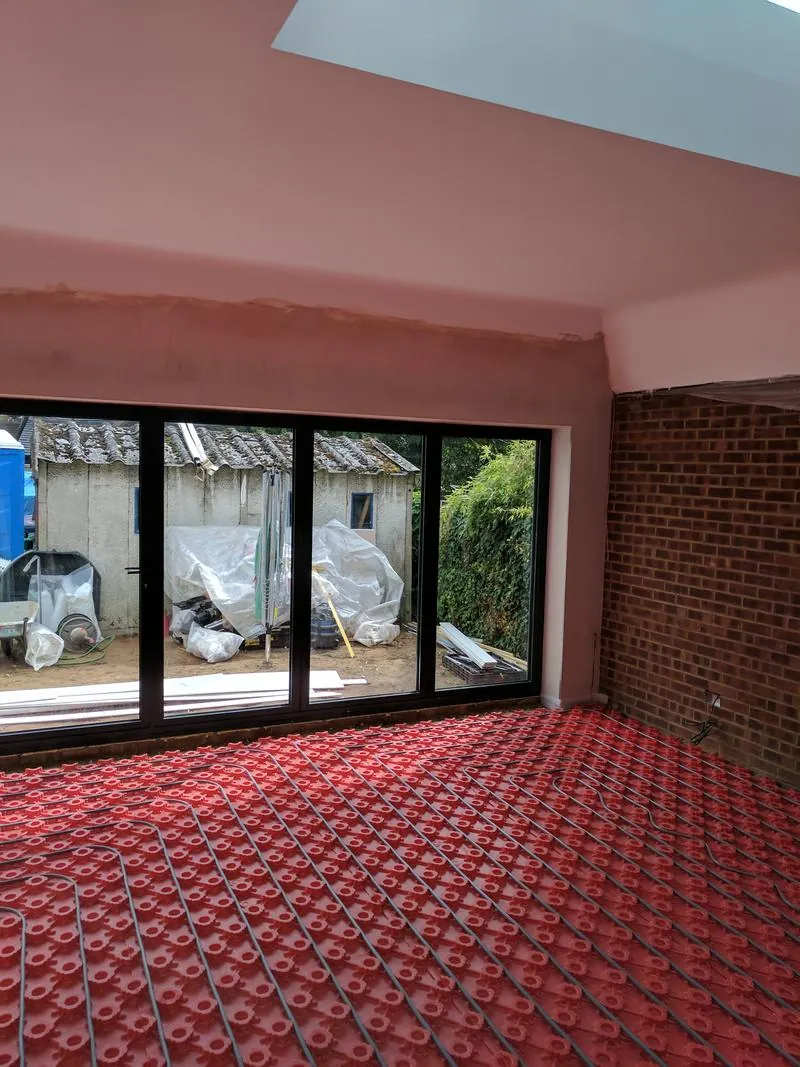
Most people live at home through an extension or a loft conversion, and most of the time it works. The new structure is built outside the house first, so for the first weeks the disruption is noise, mud and a skip on the drive. The hard part is shorter: the week or two when the back wall comes out or the loft stair goes in, and the stretch without a working kitchen. Plan those, tell your insurer, and agree the rules with your builder before anyone starts, and it is very livable.
We build almost entirely in occupied houses around Bognor Regis, Felpham, Aldwick and Chichester, so this is less a theory than a description of an ordinary working week. On Victoria Road, the family lived in the house throughout a 50m² extension, and the knock-through was programmed as one of the last structural jobs rather than one of the first, precisely so the house was a building site for as short a time as possible.
What to expect, week by week
Every job is different, so read this as typical rather than promised. It is a single-storey rear extension with a kitchen in it, which is the job people most often live through.
| When | What is happening | What it is like to live with |
|---|---|---|
| Before the start | Party wall notices, Building Control application, skip and scaffold licences, an asbestos check on older houses, clearing the garden | Paperwork, and moving things out of the way |
| Weeks 1–2 | Site set up, digging, foundations, Building Control inspects the trenches, concrete poured | The noisiest, muddiest stretch. Machinery and lorries. The house itself is untouched. |
| Weeks 3–5 | Walls up to damp-proof course, drainage, floor slab, brickwork and blockwork, steels and lintels | Regular noise in working hours. Deliveries. |
| Weeks 5–7 | Roof structure and covering, windows and doors in | The new room becomes weathertight. Still separate from the house. |
| Weeks 6–9 | The knock-through, first fix electrics and plumbing, insulation, plastering | The hard bit. Dust, the back of the house open behind sheeting, power and water off for short periods. |
| Weeks 9–12+ | Screed drying, second fix, kitchen fitting, decorating, snagging, completion certificate | Quieter, but this is usually when you are without a kitchen. Drying times cannot be rushed. |
A loft conversion runs the other way round: the scaffold goes up, the roof is opened and the dormer built from outside, and the house below is barely touched until the stair is cut through near the end. More on that in how long a loft conversion takes.
Dust: the thing everybody underestimates
Building dust is not just a cleaning problem. Cutting brick, block, concrete and tile releases fine silica dust, and the HSE's guidance for the industry is built around controlling it at source — tools with extraction or water suppression, and proper masks for the people doing it. In a lived-in house the same principles keep it out of your rooms. Ask your builder for:
- A sealed dust screen with a zip door between the works and the rest of the house, not just a dust sheet over a doorway.
- Floor protection on every route the trades walk through.
- Cutting done outside or with on-tool extraction.
- An extraction vacuum rather than a broom at the end of the day.
- The knock-through left as late as possible, once the new space is weathertight.
On your side: keep internal doors shut, move electronics and soft furnishings out of the nearest rooms, and turn off any ventilation or warm-air system that might pull dust through the house. If anyone at home has asthma or a breathing condition, say so before the job is planned, because it changes the plan.
Living without a kitchen
On a kitchen extension, you will be without a full kitchen for somewhere between a couple of weeks and several, depending on whether the old kitchen can stay in use until the knock-through and how long the new worktops take — stone and quartz worktops are templated once the units are in, then made, which can add a week or two on its own. Ask your builder for the dates, and for how many days you will be without water or a cooker.
The temporary kitchens that work are simple. A table in the dining room or the garage with a microwave, an air fryer or slow cooker, a plug-in induction hob, a kettle and a toaster. The fridge moved somewhere it can stay plugged in. A washing-up bowl in the utility or the bathroom, and a stock of easy-wash or disposable plates. Batch-cook and freeze before the start. Ask whether a temporary sink or tap can be kept running; it is often a small job that makes a large difference.

Water, power and gas
Expect short, planned shut-offs rather than long ones: when circuits are changed or a new consumer unit goes in (often most of a day without power), when new pipework is connected, and when gas or the boiler is altered. A good builder tells you in advance and in writing. Plan around the freezer and anyone working from home. Gas work must be done by a Gas Safe registered engineer, and notifiable electrical work must be certified — see the questions to ask a builder.
Builders' working hours in Bognor Regis and Chichester
Both local councils publish the hours they expect noisy building work to keep to. Arun District Council, which covers Bognor Regis, Felpham, Aldwick, Pagham, Middleton-on-Sea and Littlehampton, gives normal working hours as 8am to 6pm Monday to Friday and 8am to 1pm on Saturday. Chichester District Council's guidance is the same, and adds no noisy work on Sundays or bank holidays.
That is guidance rather than a blanket legal limit on a small domestic job, but the council can enforce it under the Control of Pollution Act 1974 if a complaint is upheld. If your job has planning permission, check the conditions too — some set their own hours, and those are binding. Private estates such as Felpham's Summerley Estate and Aldwick Bay often add their own restrictions on hours and delivery vehicles.
Do the builders use my toilet?
They can, if you agree. The welfare rules for construction sites apply to domestic jobs, and they require toilets, washing facilities, drinking water and somewhere to take a break. The HSE accepts that on a house job the homeowner's facilities can be used by agreement, provided they are available the whole time the trades are on site and are kept clean and stocked. If that does not suit you — or the only toilet is in the room being worked on — the builder brings a portable one. Either way, providing welfare is the builder's duty, not yours. Agree it before the start rather than on the first morning.
Neighbours, skips and scaffolding
Tell the neighbours before the lorries do. A short note with the start date, the working hours and a phone number buys a lot of goodwill, and if the Party Wall Act applies, formal notices have to be served anyway — see our party wall guide.
A skip on your own drive needs no licence. A skip on the road does, from West Sussex County Council, and it is the skip company's job to apply. The county asks for at least ten working days' notice; the standard fee is £65 for seven days, and the skip must be lit and coned at night. Scaffolding on the pavement or road needs its own licence, which the scaffold contractor normally arranges — the county's fee is £266 for a month. In the controlled parking zone in central Chichester, a trader bay also needs booking well ahead.
Children, pets and security
Your builder has to manage the risks the work creates for everyone in the house, which includes your family. Ask how the work area will be closed off and where materials will be stored. Keep children and pets well away from skips, scaffolding, open trenches and wet concrete — fresh cement and lime burn skin. Animals tend to hate the noise and the strangers, and gates get left open; some owners book daycare or kennels for the loudest fortnight.
Scaffolding is a ladder to your upstairs windows. Ask for the ladders to be removed or boarded at night, lock upper windows, and make sure any opening in the back wall is properly secured before the trades leave each day. Agree who holds keys or a key-safe code.
Tell your home insurer before you start
This one costs nothing and matters a great deal. Which? has warned that undeclared structural work can invalidate buildings insurance, that some insurers exclude storm or flood damage to an unfinished extension, and that if you move out, many policies limit how long the house can stand unoccupied — sometimes to around 60 days — before cover shrinks. Ring your insurer, tell them what is being built and when, and ask what they need from your builder. After the job, tell them again: the house is now bigger and worth more to rebuild.
Asbestos in older houses
The HSE's guidance is that any building put up before 2000 can contain asbestos, and plenty of houses around Bognor Regis and Chichester qualify: textured ceilings, old floor tiles, cement garage roofs and soffits, boiler cupboards and flue pipes are the usual places. Before work that could disturb it, the builder must either establish whether asbestos is there or treat it as if it is. On older houses that normally means a survey of the areas being worked on before the job starts. If something is found, it is dealt with properly before the work goes near it — and that is one of the few situations where moving out for a few days is not optional.
When moving out is worth it
Staying is usually fine. Moving out, even for a few weeks, is worth pricing when:
- the kitchen and your only bathroom are out of action at the same time;
- the whole house is being rewired, replumbed or the heating replaced, especially in winter;
- there is major structural work throughout, rather than at one end of the house;
- asbestos has to be removed;
- there is a newborn, or someone with a breathing condition or other vulnerability at home;
- an empty house would shorten the programme enough to pay for the rent.
That last one is worth asking your builder about directly. On a full renovation, being able to work in every room at once can take weeks off the job. Check your insurer's unoccupancy rules before you go.
Ten things that make it easier
- Agree the working hours, toilet and access arrangements in writing before the start.
- Ask for a programme and a weekly look-ahead.
- Clear the rooms nearest the work completely, not partly.
- Set up the temporary kitchen before the old one comes out.
- Keep one room in the house dust-free and work-free.
- Photograph the condition of the drive, path and garden before the start.
- Decide on fittings, tiles and colours early, so nobody waits on you.
- Have one person who deals with the builder, and one number you ring.
- Keep valuables and paperwork out of the way.
- Expect a bad week. There usually is one, around the knock-through. It ends.
Questions people ask about living through building work
Can you live in your house while an extension is being built?
Yes, and most people do. The extension is built outside first, so the house is only directly affected for the knock-through and the fit-out. Plan for a dusty week or two and a spell without a full kitchen, and agree working hours, toilets and access with your builder before the start.
How long will I be without a kitchen during an extension?
Usually anything from a couple of weeks to several, depending on whether the old kitchen can be used until the knock-through and how long the new worktops take to template and make. Ask your builder for the dates before work starts and set up a temporary kitchen.
What time can builders start work in Bognor Regis?
Arun District Council's guidance for noisy construction work is 8am to 6pm Monday to Friday and 8am to 1pm on Saturday. Chichester District Council gives the same hours and no noisy work on Sundays or bank holidays. Planning conditions can set different hours for a specific job.
Can builders work on Sundays?
Not noisy work, under the local councils' guidance. Quiet work inside, such as decorating, is a different matter, but anything that would disturb neighbours should stick to weekdays and Saturday mornings.
Do builders have to provide their own toilet?
They must make sure toilet and washing facilities are available. On a house job that can be the homeowner's own bathroom, by agreement, as long as it is available while they are on site and kept clean. If you would rather not, the builder brings a portable toilet.
Do I need to tell my home insurer about an extension?
Yes, before work starts. Undeclared structural work can affect buildings cover, some policies limit cover for unfinished work, and if you move out there may be limits on how long the house can be empty. Tell them again when the job is finished.
Do I need a permit for a skip in West Sussex?
Only if the skip goes on the road or pavement. Then the skip company applies to West Sussex County Council, at least ten working days ahead. A skip on your own drive does not need a licence.
Should I get an asbestos survey before renovating?
If the house was built before 2000 and the work will disturb ceilings, floors, boxing-in, garage roofs or old boiler areas, yes. Your builder must establish whether asbestos is present or treat it as present before starting, and a survey of the areas being worked on is the normal way to do that.
Where these facts come from
- Arun District Council: section 61 consent and normal working hours.
- Chichester District Council: construction noise.
- HSE: welfare facilities on construction work, and CDM 2015 Schedule 2.
- West Sussex County Council: skip licences and scaffolding licences.
- HSE: asbestos, and Control of Asbestos Regulations 2012, regulation 5.
- Which?: will your insurance cover home improvements (July 2025).
Price match guarantee

We will never compromise on quality but we will match any like-for-like price.
The words doing the work there are like-for-like. A quotation that comes in cheaper is usually describing a different job underneath. A shallower footing. A thinner unit of glass behind the same three words. Making good dropped, so the decorating lands back on you at the worst possible moment. A scaffold nobody priced, arriving in week three as an extra.
None of that makes the other builder a crook. It makes the two pieces of paper impossible to compare until somebody opens them both up, which is the whole reason ours arrives as over two hundred itemised lines rather than a figure at the bottom of a page.
So bring the other quotation to the site visit and we will go through it against ours, line for line. Either your price gets matched, or you find out what the cheaper number quietly leaves out — and either of those is worth an hour.
Read the price match guarantee terms — what counts as like-for-like, how long a match holds good, and why one builder's total can sit a fifth below another's before anybody has lifted a tool.
Related guides
15 questions to ask a builder before you sign
Insurance, company and VAT checks, references, deposits, Building Control, party walls, guarantees and waste — and how to check each answer yourself.
Read the guideHow long does a loft conversion take? A week-by-week guide
From first drawings to the completion certificate: the approvals, the notices, and a week-by-week build for a rooflight, dormer or hip-to-gable.
Read the guideKitchen extension or kitchen refit: which makes more sense?
Refit, knock through or extend: the cost of each, what adds value, planning and Building Control, and the questions that decide it.
Read the guideNext step
If the drawings exist, send them and a priced quotation comes back. If they do not, the site visit is the way to find out whether the job can be done at all.
Or the landline on 01243 256796, or WhatsApp if it is easier to send a photograph. Reply within one working day, every time.